
The Science Behind Trick Shooting
This month I want to talk about trick shooting. No doubt if you have seen any YouTube videos about trick or exhibition shooting you have put your phone down in amazement. No matter how many times I’ve watched Tom Knapp, I’m amazed. If you are a shooter, you have always wanted to put your second shot in the same bullet hole of your first shot.
Tom Knapp
I’m not sure when trick shooting started, I have a feeling that it started as far back as when firearms were invented. That is just how we humans are. We invent something, then after we have mastered it, we start to play with it. We try to stretch the limits of the invention as well as ourselves.
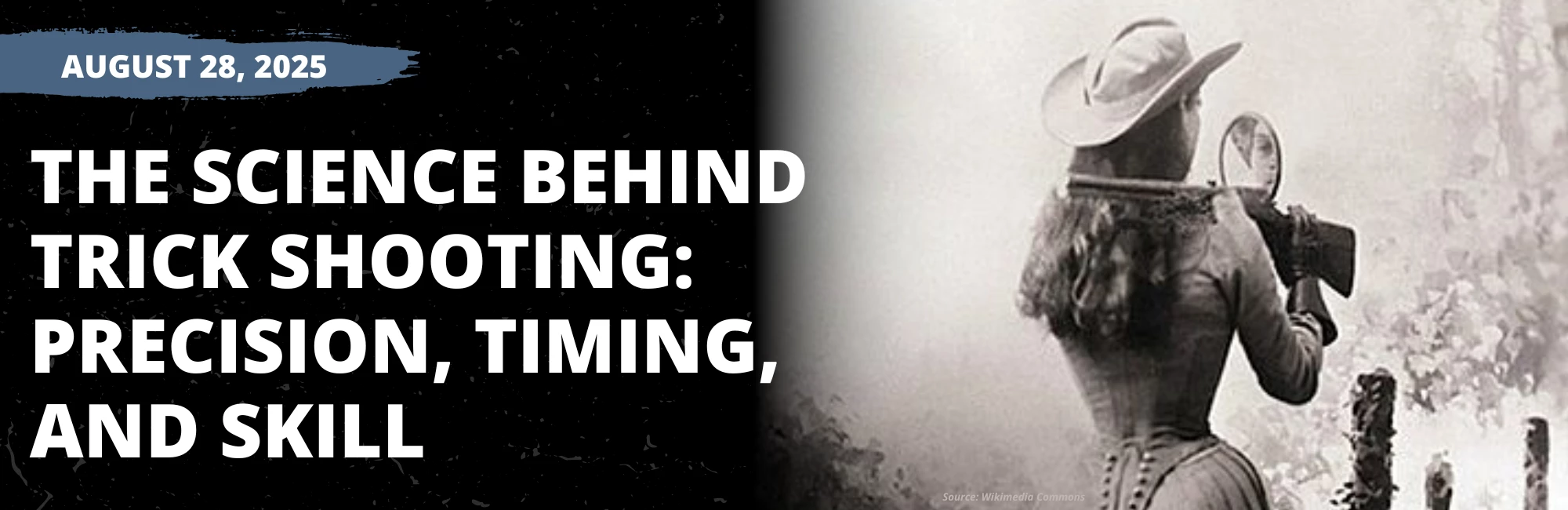
Trick shooting started to become recognized and later popular in the late 1800’s when William Cody, aka Buffalo Bill, launched “Buffalo Bill’s Wild West Show”. This traveling circus like show featured main events that re-enacted famous western battles, horse races, trick horse riding, and exhibition shooting. One of the most famous trick shooters was Annie Oakley. She won her first shooting competition when she was 13. She went on to show her skills in front of presidents and British Royalty. She could shoot cigars out of her husband’s mouth, use a mirror to shoot behind her back, and shoot dimes out of the air. It’s hard to imagine guns made from 1800-1900’s technology could shoot dimes out of the sky, but they did.
Annie Oakley; Trick Shooting with a Mirror
Another famous shooter, Elizabeth Topperwein, who shot professionally for Winchester could shoot buttons of her husband’s vest and still holds the record for a female shooter hitting 967 of 1000 clay pigeons with a 22 rifle. In contrast, I can barely hit them with a shotgun. Elizabeth’s nickname was “Plinky”. That is why they call small arms shooting “Plinking”.
As firearms evolved, so did trick shooting. Smoother and faster shooting revolvers helped Ed McGivern put 6 holes in a tin can thrown in the air. A record that has been challenged many times but never beaten. He was also known for many other speed shooting records and shooting dimes and nickels out of the air. A challenger to McGivern and his multiple shooting records is Jerry Miculek. In my opinion, Jerry is by far the best exhibition shooter of all times. He holds many world records including 15 records using firearms from a standard revolver to a Barrett 50 Caliber rifle. He’s mostly known for his speed shooting abilities. He has been recorded shooting 12 shots from a six-shooter revolver in less than 3 seconds. That means he shoots six rounds, ejects the empty casings, reloads and shoots six more rounds. It took me longer to write that last sentence than it took him to shoot 12 shots. It is an absolutely incredible achievement, for anyone, and Jerry is 70 years old and still at it. His family has followed in his footsteps and some of them hold records as well.
The Science Behind Trick Shooting
So, is there science behind all these phenomenal feats? Is it mathematics? The study of geometry, velocities, trajectory, and mother nature? All these principles are definitely important, but they are all enhanced by continual practice. Learning what your firearm is capable of is the most important aspect of trick shooting. Firearms act differently when they are clean versus having a dirty gun. Different types of ammunition act differently in every firearm. When you look at ballistic charts in reloading manuals you can see how the velocity changes with different powders and bullet weights. Velocity changes trajectory and trajectory can be affected by your outside shooting conditions. Wind also plays a huge role in trick shooting, as well as the temperature and humidity. Knowing what these conditions are, and how it changes your bullet trajectory helps you know your aiming point. It was said that the late great racecar driver Dale Earnhardt could see the wind and air around him and his car. And that was why he won so many races. In actuality, he wore an open-faced helmet so he could feel the air around him. He would adjust his racing style depending on the environment around him; he could feel what lane on the racetrack made him faster or had the least amount of resistance. How did he figure this out? He didn’t sit at a desk and crunch the numbers, he learned from countless hours of racing. He competed in over 800 races and before each race he would practice. In the off season he would practice. Comparing notes from the last race. Golfers do the same thing, practice, take notes, learn the course conditions.
Conclusion
I mentioned above knowing the great importance of every detail of your firearm and its capabilities. Also equally important is understanding the ammunition you use and how to determine your aiming point. These two components are areas you can modify. Making a trigger a lighter pull weight will help you shoot better. Polishing internal parts and changing out springs will make the firearm smoother to shoot. There isn’t a trick shooting barrel you can install or a special ammo to use to make it find the target. Every one of the trick shooters of the past and present practiced and had the physical and mental talent to perform the shots they did. Thousands of rounds over hours of shooting helped the perfect their shooting achievements. Just like Earnhardt, they all learned how mother nature can affect their targets, velocities, and trajectory. They understood how everything added together would make them successful.
You can use the same principles in becoming a Gunsmith. You learn by physically doing the work. You can watch videos and read books on how to polish a firearm and prepare it for rebluing. That doesn’t make you an expert, but years and years of practice will. Continual practice will make you a master of your trade.
Semper Fi!
Written by: David Johnson, Leatherneck Gunsmithing
