
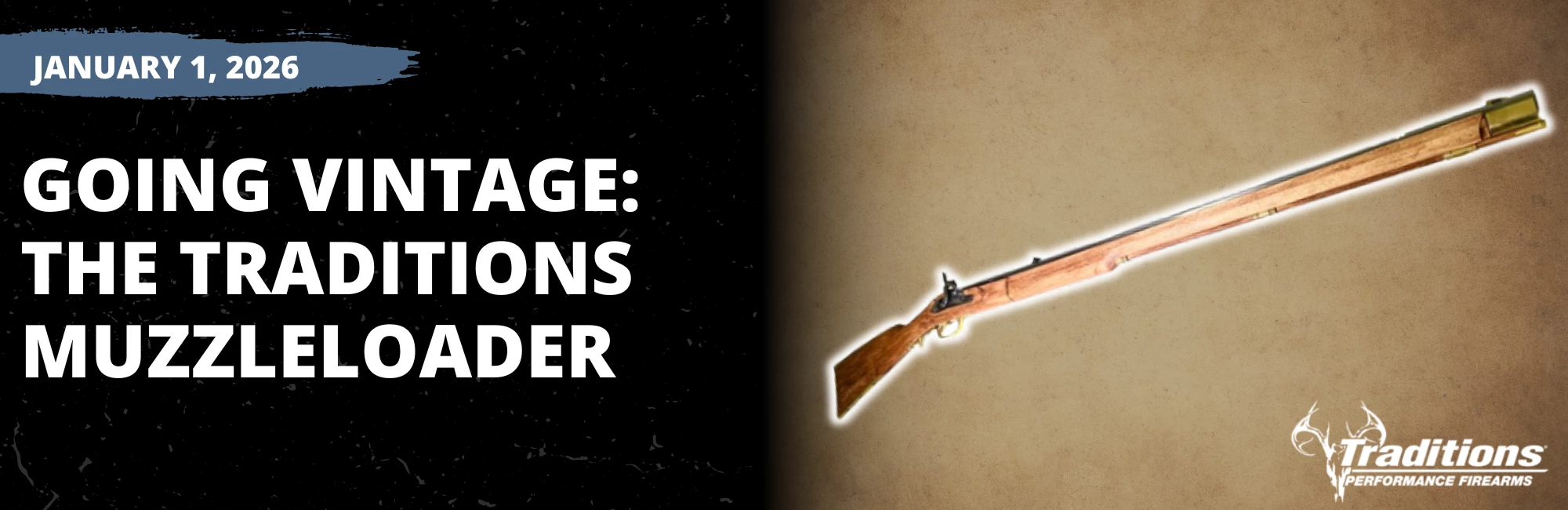
Going Vintage: The Traditions Muzzleloader
Mastering a firearm like the Kentucky long rifle may sound like a pastime that’s only for history buffs. To the uninitiated, its temperamental flintlock ignition and the time consuming need for muzzleloading can sometimes sound more like a burden than a benefit. But muzzleloaders offer some unique benefits to hunters, and a welcome challenge to target shooters who are looking for a new range companion. Modern muzzleloaders have come a long way since the long rifle, and heavy wrought iron has been mostly abandoned for more modern sensibilities, making muzzleloaders even more awesome than they were during the American Revolution. If you’re considering “going vintage,” this article will get you started.
Is a Muzzleloader for You?
If you can contend with a limited range of around 250 yards (though some modern muzzleloaders boast double that range), you don’t mind a little blackpowder smoke, and you’re not looking for high performance in wet weather, a muzzleloader is a great choice for hunting and target shooting. The blackpowder smoke does have a brief odor to it, so if you’re scent masking on your hunting trip, or hitting the range before a hot date, consider yourself duly warned! Of course, it’s worth noting that there are, of course, black powder substitutes available for some ignition systems, and they’re far less pungent (more on that later). That aside, there are some unique considerations for both hunters and range shooters who are thinking about picking up a muzzleloader and honing a new skill.
Muzzleloader Considerations for Hunting
Hunting with a muzzleloader might seem like an eccentric choice to some. It’s an old world approach to hunting that doesn’t allow for the same degree of long range precision. And that’s exactly why it’s embraced by those who love it. The high stakes of having a single shot at your disposal changes everything. Shots require a degree of care and consideration that’s completely unique to this style of rifle. And those who are up for the challenge often benefit from different (and in some cases, longer) hunting seasons, and often find themselves in competition with fewer hunters.
If you can find success with a muzzleloader, you have the potential to find success with anything. It’s a no-frills firearm for those who don’t mind their tools being a little Spartan. And for those who might assume that a vintage tool requires the burden of vintage weight, most modern muzzleloaders are between 6 and 8 pounds. If you’re looking to create your family heirloom, the Traditions Kentucky Muzzle Lock Kit has an unfinished carbon steel barrel, which, once blued, will offer a modicum of water resistance. And there’s always water resistant oil or wax for those who live in wetter climates. If you’re comfortable with something even more modern, Tradition’s Nitrobolt comes stock with a Cerakote finish, a floating barrel, and a glass-bedded stock. They even have an adjustable length of pull.
Modern upgrades may seem redundant if you’re looking to get back to basics, but it’s worth noting that using a muzzleloader can be a unique experience to the uninitiated. Loading can be a more time consuming process, and recoil has a much softer impact than it does with many other rifles. So, hitting your mark can feel somewhat easier on the shoulder, but missing your mark while hunting can obviously mean a forgone opportunity altogether. Most hunters can confidently bring down big game with a bolt action rifle, but achieving the same success with a muzzleloader can require an entirely different skillset that only some have the patience and dedication to master.
Muzzleloaders for Target Shooting
You may also find that a muzzleloader makes for a good target shooting companion. Granted, you’re not going to be squeezing off multiple rounds at a time, and muzzleloaders offer other challenges to consider. If you’re using a traditional antique style muzzleloader with an open sight, you may find the lack of advanced optics, and unfamiliar recoil to be a challenge. You’re also likely to find that muzzleloaders are much more susceptible to wind drift than their modern counterparts. But muzzleloaders offer some benefits as well. For example, the softer recoil is less likely to cause fatigue or flinching that some of the larger traditional calibers may have. You may find the time spent reloading between shots to be calming, and it can help a shooter concentrate on all the shooting principles that to make each shot count.
Caplocks, Flintlocks, and In-Line Options
Muzzleloaders fall into three categories of ignition systems. The history buffs out there know that a flintlock works by striking a steel plate against a flint in order to make a spark. Its successor, the caplock, creates its ignition by striking a percussion cap with a spring-loaded hammer. And while cap locks are more reliable than flintlocks in wet weather, neither are ideally suited to a rainy day. It’s also worth noting that cap locks are more resistant to fouling, though it goes without saying that a good marksman likely won’t be deterred by either option. Both caplock and flintlock rifles are sidelocks, which simply means that the firing mechanism is attached to the side of the action.
If you don’t mind a more modern muzzleloader, opt for in-line. In-line ignition systems have a primer that’s in-line with the power charge in the barrel, and they’re less susceptible to wet weather than their muzzleloading predecessors. They have a practically airtight breech, which protects the ignition from the elements. The modern sensibilities of the inline muzzleloader may deter some purists, but it’s every bit as elegant as its predecessors.
Ammunition will obviously need to be seated with a ramrod on any muzzleloader, but that doesn’t mean that you always have black powder to contend with. Caplocks and in-line muzzleloaders can sometimes benefit from black powder alternatives like Pyrodex, which means less smoke to contend with, and increased moisture resistance- though it can require more clean up to prevent rust. It’s worth noting that there are those who do use black powder substitutes with some flintlocks, but that typically requires preloading with a small amount of a black powder first. This adds extra time onto loading, so it’s hard to recommend a flintlock to anyone who wants to use a black powder substitute. However, as they say, your mileage may vary.
For a deeper dive on muzzleloader ignition systems,I recommend checking out Alice Jones Webb’s article on ammunitiontogo.com.
The Traditions Muzzleloader
While there’s no shortage of muzzleloaders on the market, enthusiasts with some experience under their belts, or a little guidance from a mentor, shouldn’t shy away from the challenge of putting one together themselves. If your gunsmithing journey brings you to MGS (shameless plug ahead) you should know that the MGS Advanced II gunsmith career training course includes your choice of school-selected builds. And the Traditions muzzleloader is a great option.
Building a muzzleloader isn’t just about honing your skills for historic restorations; it’s about carefully crafting the simplest of tools into a must-have item. It cannot be overstated just how many skills you’ll develop during your build: filing, staining, woodworking, and making something your forebears would be proud of. So, whenever you’re ready to take that next step, rest assured that MGS will be there.
Written by: Lanna Perkins, Educational Writer
